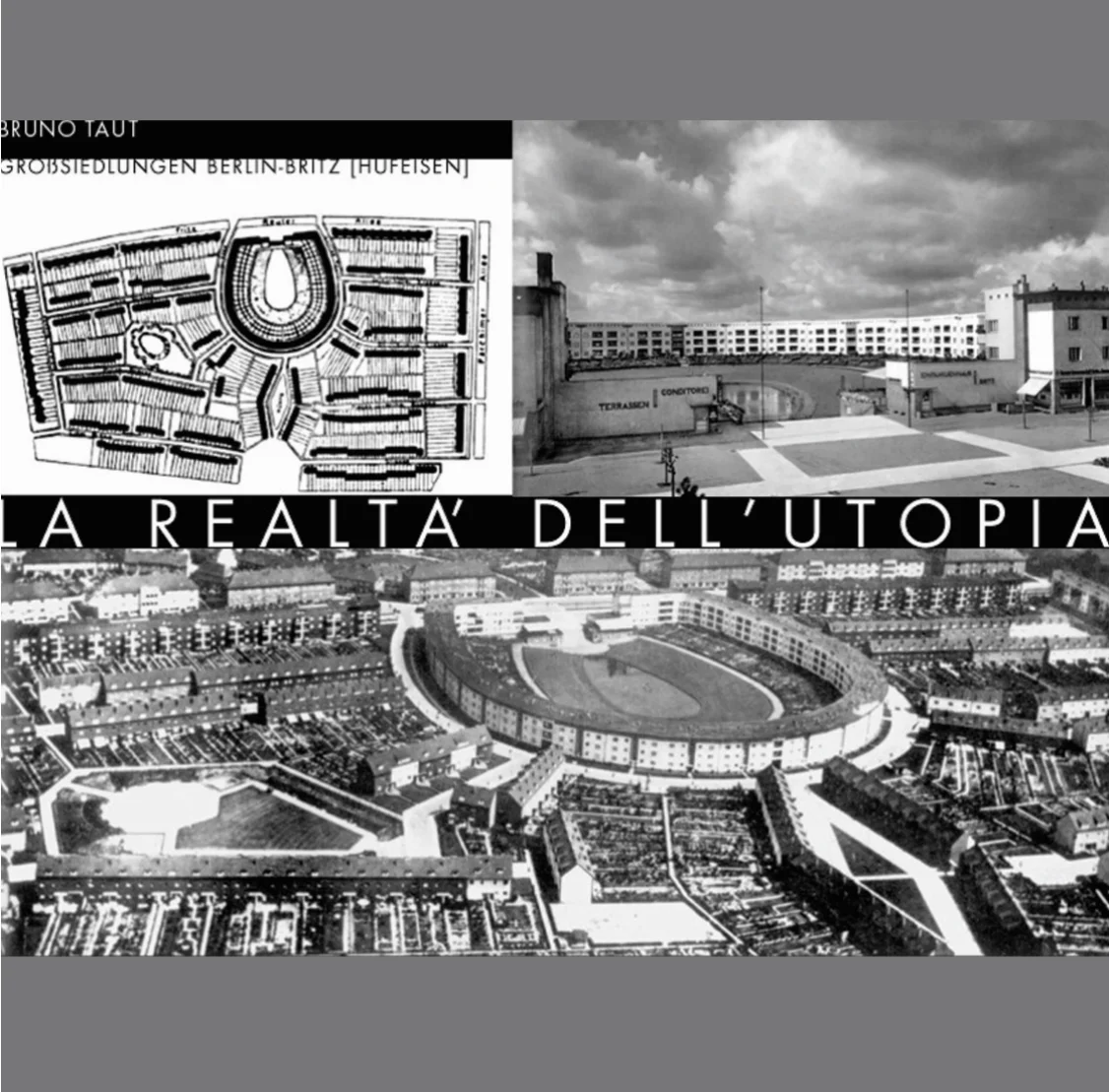
REALITY OF UTOPIA
The reality of utopia is dedicated to Bruno Taut and his awareness of a strong moral law.
His utopian drive cannot be considered exhausted in mere theoretical speculation but has been the necessary condition to concretely build the real city within a larger humanitarian design.
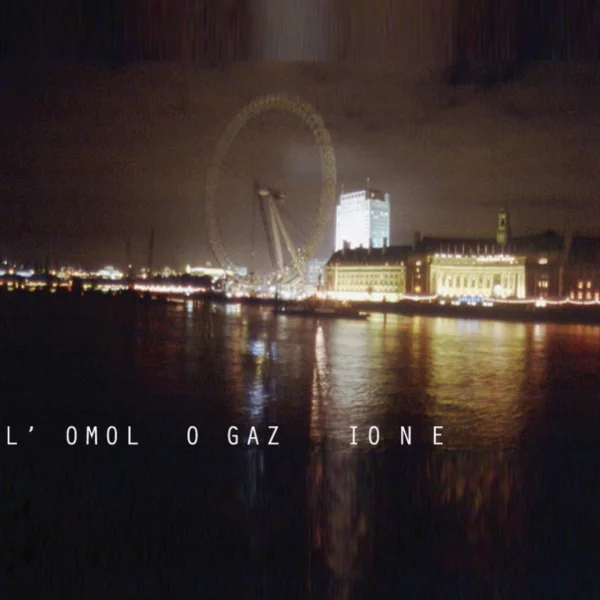
HOMOGENISATION
Homogenization is dedicated to the "globalization" that transforms cities into unlimited expo to specific and continuous spectacle effectively nullifying the identity of places that are increasingly characterized by being frequented by crowds of similar but lonely individuals. Much of contemporary architecture is marked by this contradiction: it deals with localized individuals, identified and socialized only at the entrance or exit. Space no longer has the character of expressing utopia: it exists and accommodates no organic society.
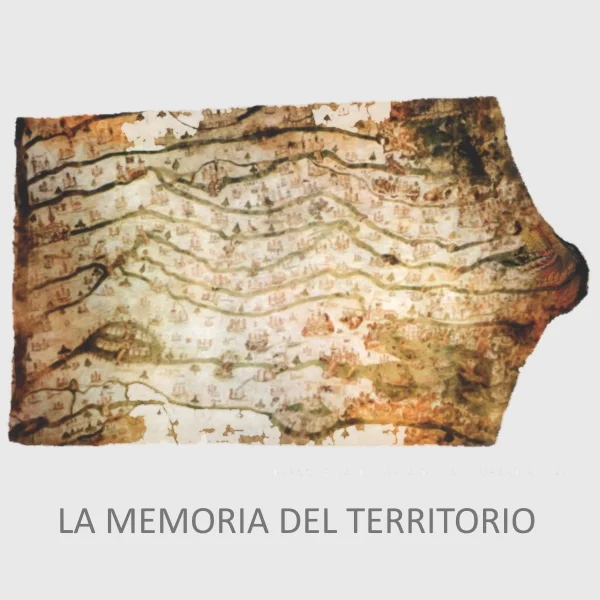
MEMORY OF TERRITORY
The memory of the territory is dedicated to horizontal communication. The map of Lombardy drawn by Giovanni Pisato in 1440 presents us with a vast urbanized territory in which the plot drawn by nature with its watercourses, mountain peaks and forests, and that drawn by man with its towns, convents, refuges and paths merge into a system that can be read through the signs that characterize the environment and all constitute, in some way, interdependent references.
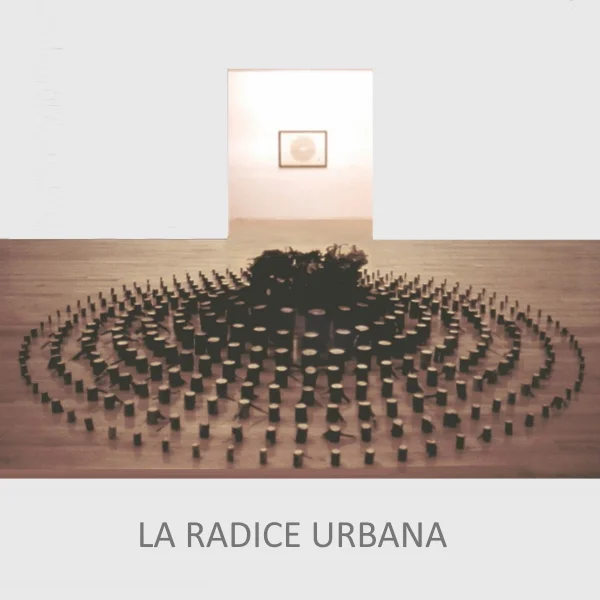
URBAN ROOT
The urban root is dedicated to the individual capable of experiencing a synchronicity that is not frustrating but primarily connected to processes that take place in the unconscious, hence conscious. To the unconscious psyche, space and time seem relative, i.e. knowledge is located in a space-time continuum in which space is no longer space and time is no longer time. If therefore the unconscious develops and maintains a certain potential to consciousness, the possibility of perceiving and 'knowing' parallel events arises.
Carl G. Jung, Synchronicity.
So, on the cusp of our bucket, we will peer into the new millennium, without hoping to find anything more than what we are capable of bringing. (1)
The idea of Syncrostudio was born on the occasion of participating in the international competition "city of the third millennium" (four digital images of the city of the future) announced in the 1999-2000 edition of the VII Architecture Biennale in Venice:
LESS AESTETHIC MORE ETHIC
Starting from the assumption that ethics and aesthetics are not separate, nor are they competitive to prevail over each other, we considered a division necessary, as well as a game for reading, in which each image becomes context and frame for the others.
These are not separate images but different facets of the same City-Medal synchronized on a path that can prove to be a device capable of communicating and producing, simultaneously, a time of meaning and a sense of time.
Rather than abstract images, we sought to express an idea of a future city that roots itself in nature and calls into question a way of experiencing time, recovering its meaning.
The speed with which the presence of others and things becomes virtual, pain and pleasure as information, transforms our senses into slippery surfaces, lacking real stimuli. Simulation affects the object and the essence of our feelings, compromising the individual's ability to relate synesthetically the mind and soul with different environmental stimuli.
On the other hand, an increasingly globalized, manipulated, transformed, and threatened environment in its physical and territorial body is synonymous with a crisis of thought that deeply affects social and political models, placing us in the face of an ethical crisis in society. Faced with this, the potential of technologies should not be removed but rooted in human beings, according to a strategy of implementing sustainable processes capable of countering dematerialization, but above all, the advent of automatic democracy: media democracy, instantaneous, without reflection, of pure reflex (2), where the sense of objects, narration, and history vanishes.
The gap of globalization, understood as the absolute power of the market and its technologies, generates in the individual a continuous tension towards success as pure financial competitiveness, leading them to build forms that respond to homogeneous mass and consumption behavior rules.
"The true distances, the true measure of the earth, are in my soul" (3).
Recovering the sense of time and matter means searching for a balance sign in the project that consciously grafts itself into its role among the energies, resources, and images of the human landscape, in the overall framework of a philosophy of evolution in terms of sustainability.
From the desire to overcome the barrier of formal structures that suffocate the environment and imprison the work, this attempt to research a design that orients itself along an organic and synchronous path is born: organic in that it refers to the concept of a living organism, a necessary principle that regulates the internal and environmental structural connections between the parts and the whole.
Synchronous in that it is an act of characterizing the present as a time of identifying what is related to places, their history, their culture, and it is the desire and project of the future.
The history of modern architecture has confirmed a possible path towards the organicity of architecture in which the predominant element is a human composed of soul and body: Arts and Crafts, Art Nouveau, expressionism, Neues Bauen, anthroposophy, the American organic movement, Scandinavian empiricism are examples of historical movements that draw their origins from nature and continue to this day.
"What good is it for a man to gain the universe if he loses his soul, a soul that moves him and allows him to be animated and in love at the same time, to draw the other, the environment, the proximity with his movement to himself?" (2).
(1) Italo Calvino, Six Memos for the Next Millennium
(2) Paul Virilio, Speed of Acceleration
(3) Armenian saying