PARSIFAL
The Value of Co-design
Slide 1/8
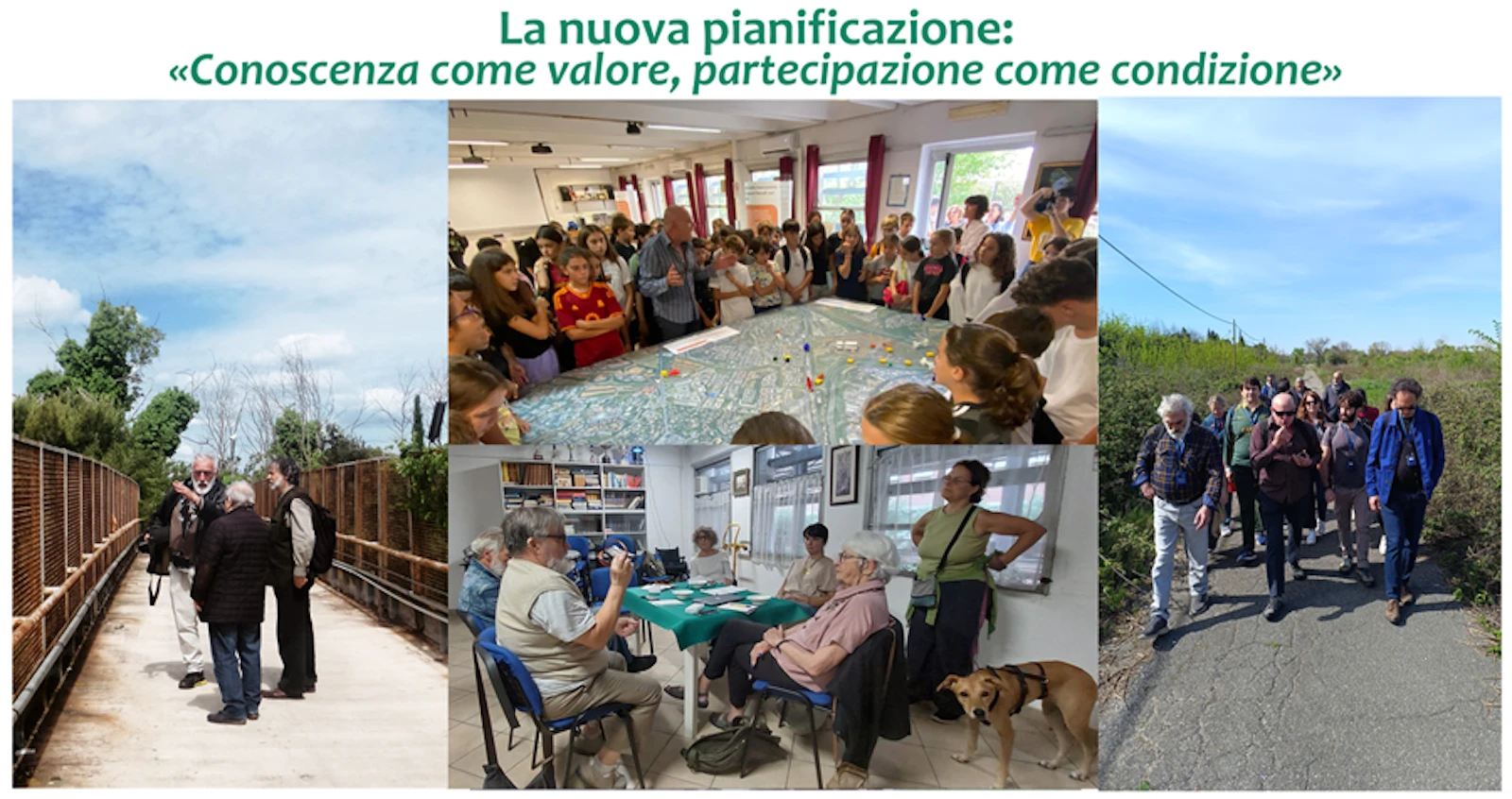
Around the proactive idea of the PARSIFAL project (Parco Agrario Romano Scientifico Interdisciplinare Fiume Anima Libera), a synergy has grown between Active Citizens, local associations and the 9th District. This has produced not only the Collaboration Pact for the protection and safeguarding of the area, signed on 28/07/2022, but also the awareness that, beyond ownership rights – public or private – there is the fundamental right to regard a vast river ecosystem as a Common Good belonging to all the citizens of Rome.
Since September 2023, within DecimaFest, the Decima 50 Association has introduced a thematic section dedicated to PARSIFAL. Exhibitions, events, debates, walks, thematic meetings with residents and students from the neighbourhood have provided the first information to nurture the humus of future co-planning.
Within the Department for Agriculture, Environment and Waste Cycle we have found an open door and a shared set of interests and objectives, making it possible to launch a programme of actions aimed at a broad environmental regeneration of the Tor di Valle area.
In June 2024 the Department for Environmental Protection commissioned the drafting of a “DocFAP – Documento di Fattibilità delle Alternative Progettuali, preliminare alla redazione del programma per la riqualificazione ambientale del bacino fluviale di Tor di Valle – Zona Z.XXXIX dell’Agro Romano”, with the subtitle “P.A.R.S.I.F.A.L.”.
The DocFAP was delivered in August of the same year, 2024.
Territorial Framework of the Park
Slide 2/8
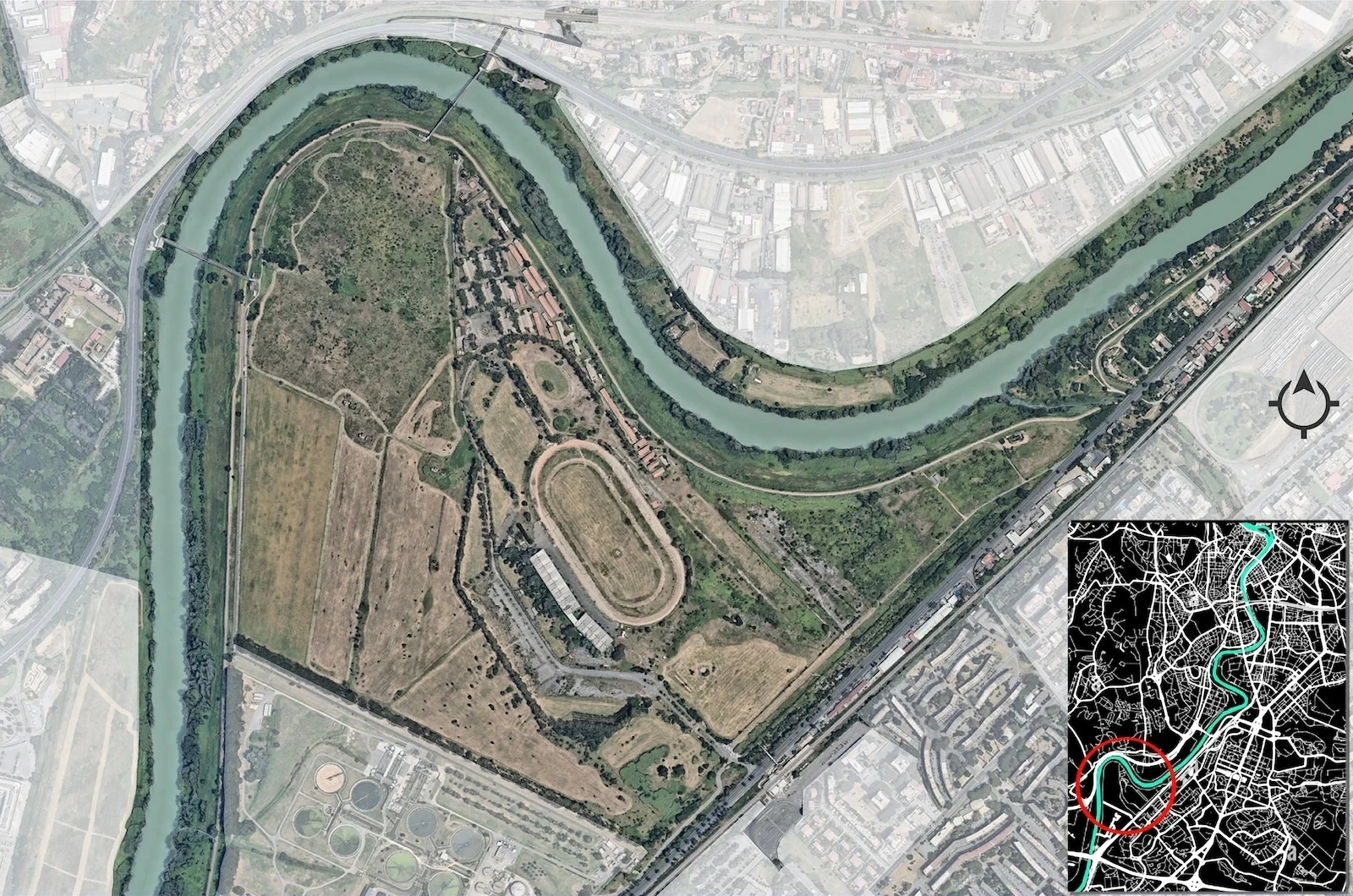
The territorial area involved in the environmental redevelopment in the South/West quadrant of the city covers approximately 2,000,000 square metres (200 hectares).
The idea of transforming Tor di Valle into a Park, Agrarian, Roman, Scientific, Interdisciplinary space dedicated to the Fiume Anima Libera, through integrated, open and shared planning workshops, is presented in Enrico Cerioni’s book Roma oltre la deriva per la rigenerazione umana della città, Ed. Bordeaux, Rome 2021.
Hydrogeological Risk
Slide 3/8
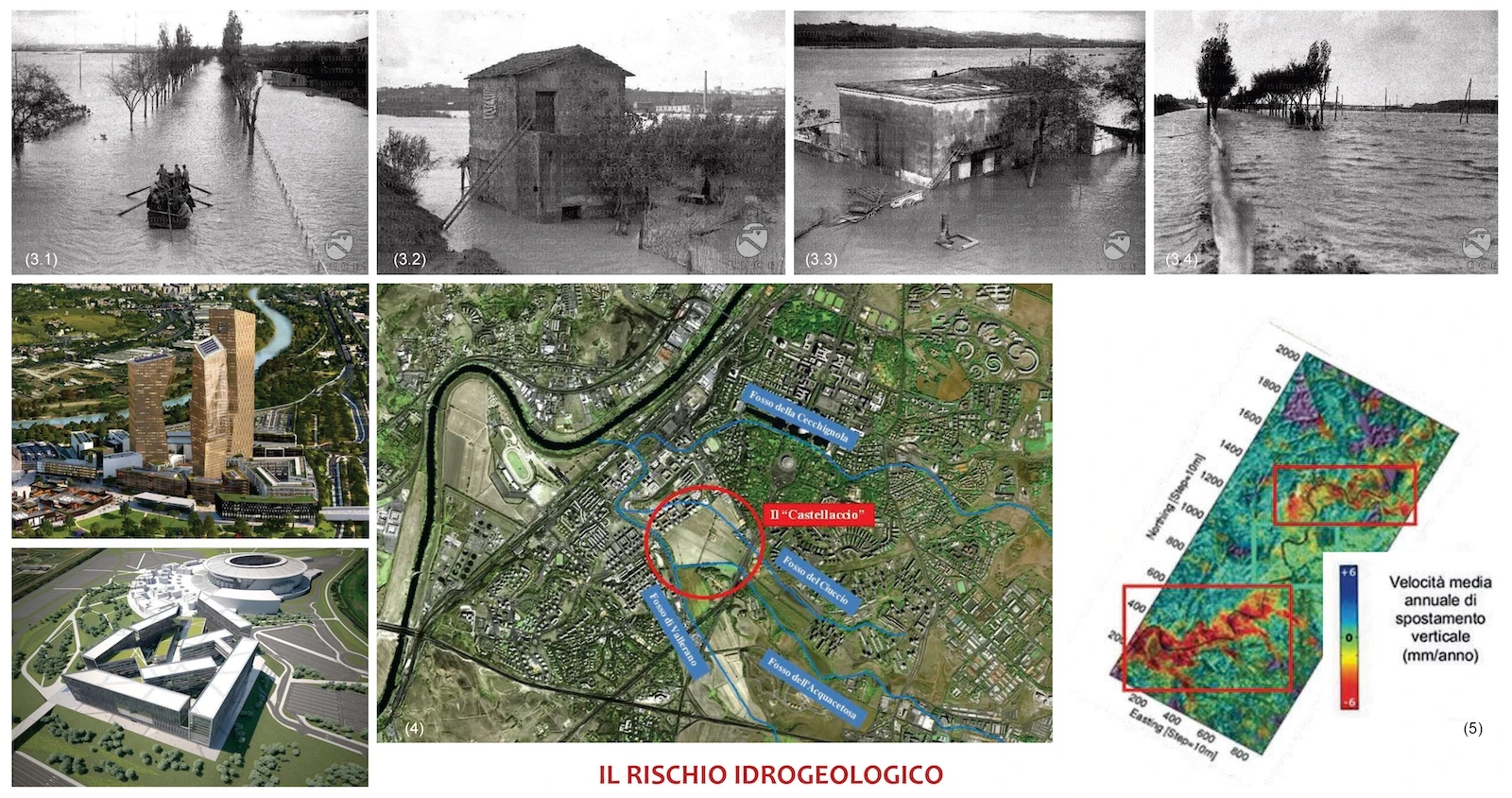
The presence of artificially impermeabilised areas not only tends to increase the volumes of water destined for collectors, but also substantially alters their distribution over time, since water runs quickly over surfaces instead of flowing slowly, as happens on natural soils which partially absorb it. This means that the response of a drainage basin to rainfall will be much faster and further intensified by the rainwater drainage network that accompanies the development of an urban area and accelerates even more the conveyance of water downstream, always at the expense of base flow. And so, due to soil impermeabilisation and the increased hydraulic efficiency of drainage networks, that fundamental parameter known as the lag time is substantially modified during rainfall events. “The combined effect of the increased volume of surface runoff and the reduced water disposal time results in the rise of peak flows, which is perhaps the most evident effect of the urbanisation process.”
Environmental Degradation
Slide 4/8
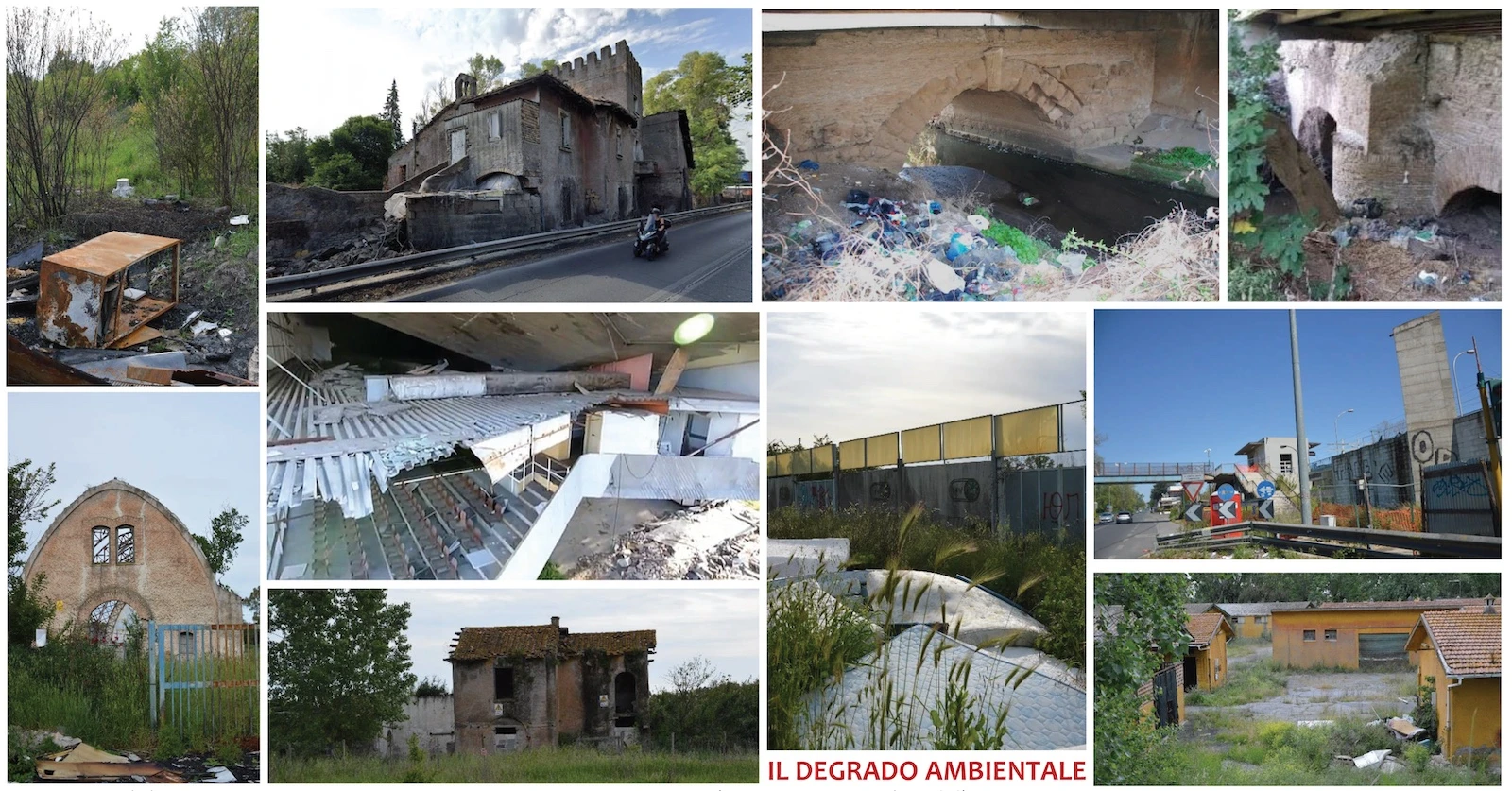
Since the day the Racecourse closed, on 30 January 2013, the entire Tor di Valle area has been in a state of total abandonment. Twelve years later, we are faced with a real environmental disaster. Dumping of mixed and even special waste, combustible materials and used oils, fires releasing dioxin into the air, devastation of the Racecourse.
Tor di Valle: the landscape and its river ecosystem
Slide 5/8
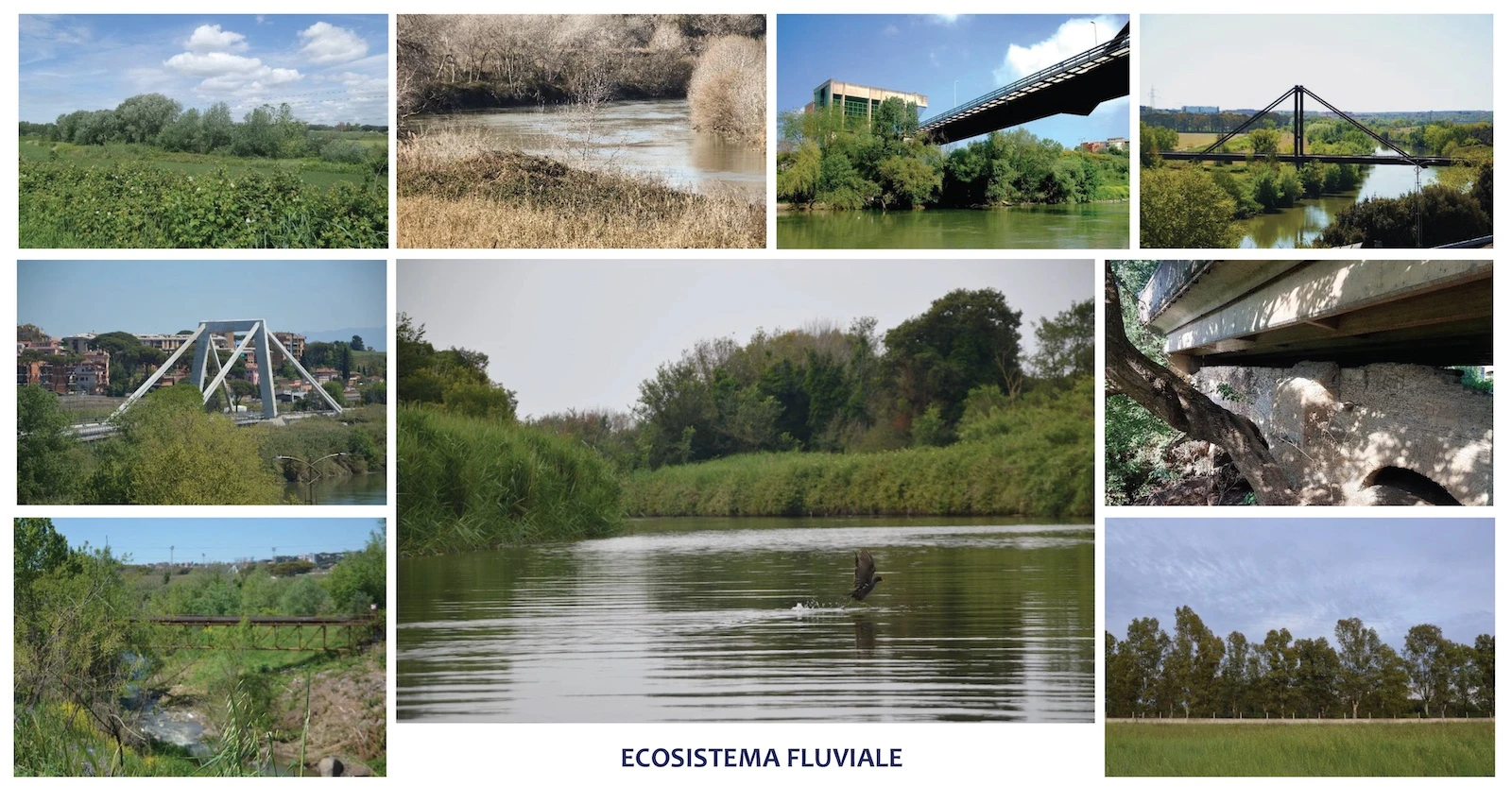
The Tor di Valle basin is a confluence area between the Tiber River and its two tributaries, the Fosso della Magliana and the Fosso di Vallerano, respectively on the right and left banks. From the perspective of ecological features to be preserved, the Tiber River Basin Authority, through the Sector Plan for the metropolitan stretch from Castel Giubileo to the river mouth (P.S.5), identifies the river area as a fluvial corridor and specifically designates the Tor di Valle zone as a River Park. Its ecosystem and landscape value are protected under all current regulations.
Agriculture and the Park
Slide 6/8
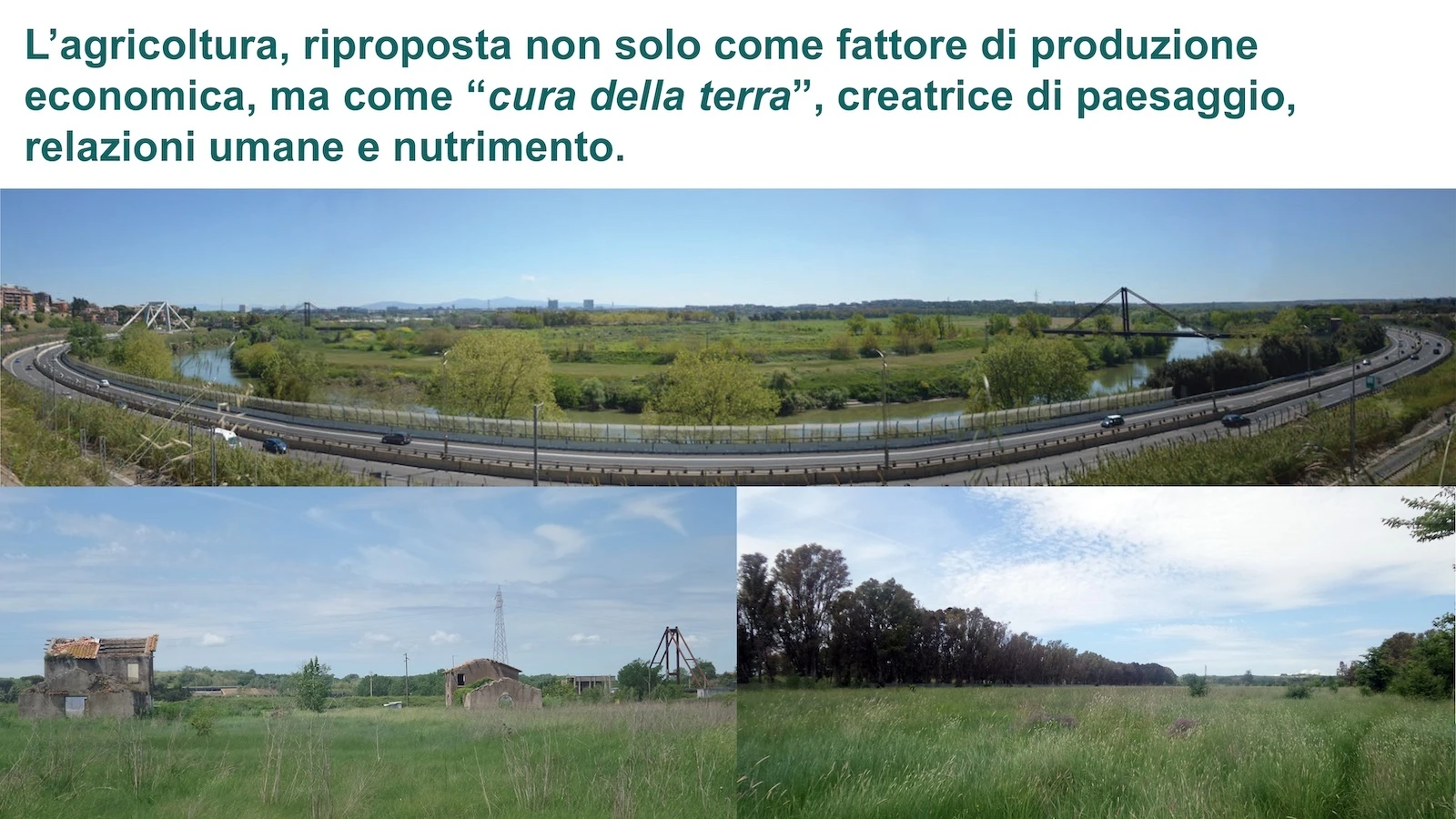
In addition to its fundamental role in food production, agricultural activity is also recognized as contributing to land stewardship, the prevention of environmental disasters, the preservation of biodiversity, and the mitigation of climate change. Within the park, with its 60 hectares of arable land, agriculture also plays an economic role expressed through a wide range of productive activities:
• Integrated agricultural activity with a conservation-based crop rotation system;
• Research activities;
• Agri-food activities;
• Fruit and vegetable production;
• Extensive livestock farming;
• Dairy production;
• Educational and recreational activities;
• Aerobic composting plant with educational and training value;
• Activities with schools: programmes and workshops;
• Training and professional development activities on topics such as: organic physical materials and their deterioration; waste collection methods; hygienic, sanitary and environmental risks; management systems, technological processing systems; circular economy; local, regional, national and European regulations.
Tor di Valle Racecourse. A Modern Monument to Be Enhanced
Slide 7/8
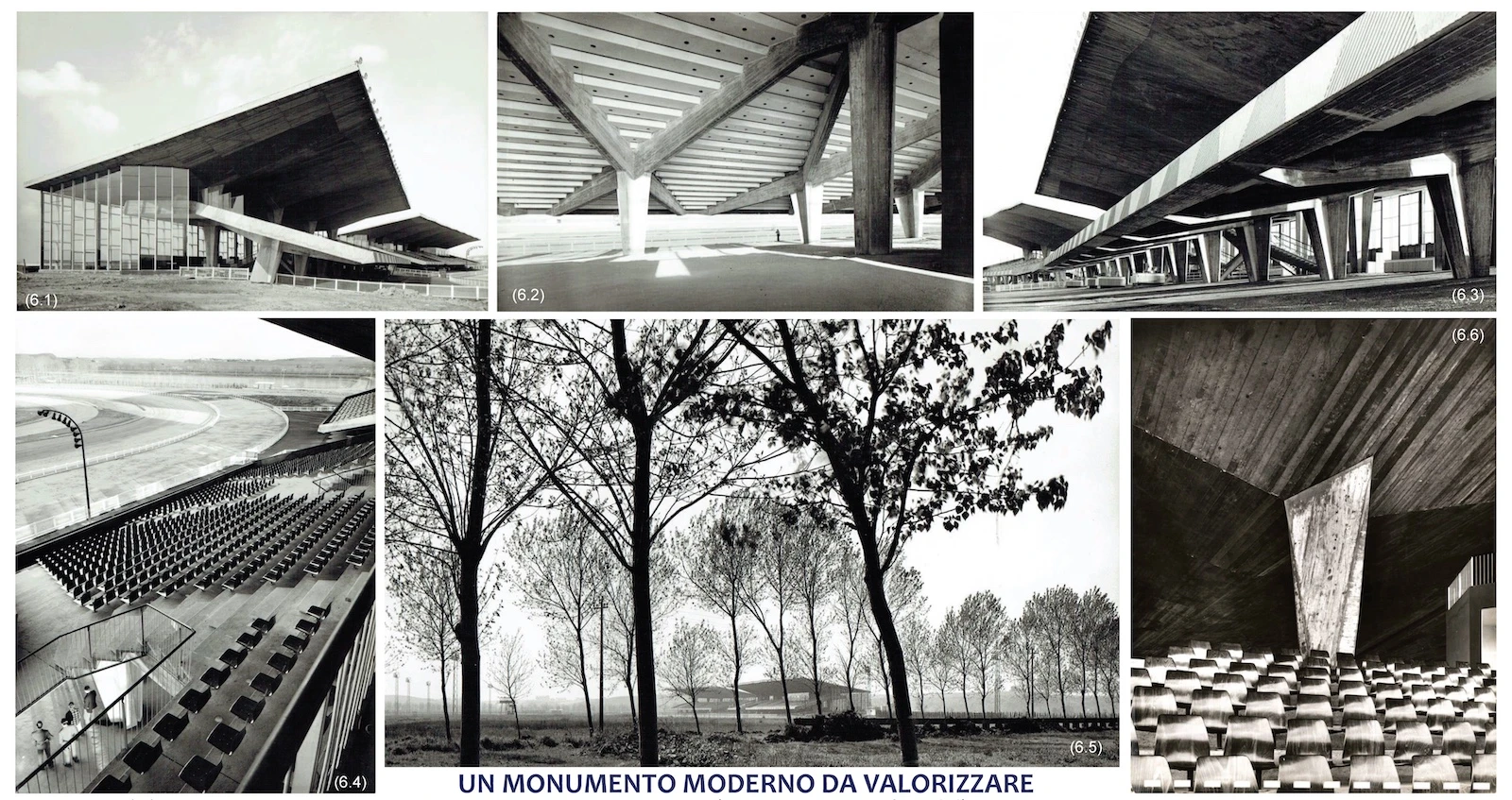
The Tor di Valle Racecourse is one of the most significant architectural works of modern Roman architecture. An innovatively engineered structure, it was built for the 1960 Olympic Games by Julio Lafuente, Aicardo Birago, Gaetano Rebecchini, Paolo Vietti Violi, and Calogero Benedetti. Its design features eleven self-supporting vaults resting on eleven pillar-sculptures evoking equestrian themes, tied together by tensile elements.
It is included in the “Quality Charter” of the current Master Plan and is listed among the works of significant historical and artistic interest built from the post-war period to the present day. These works have been surveyed as part of a project curated by the Directorate-General for Landscape, Fine Arts, Architecture and Contemporary Art (PaBAAC) of the Italian Ministry of Cultural Heritage (MiBACT), with the aim of promoting and initiating actions for their protection and enhancement.
The complex covers a total surface area of 420,000 m².
A Park Capable of Providing Services and Employment
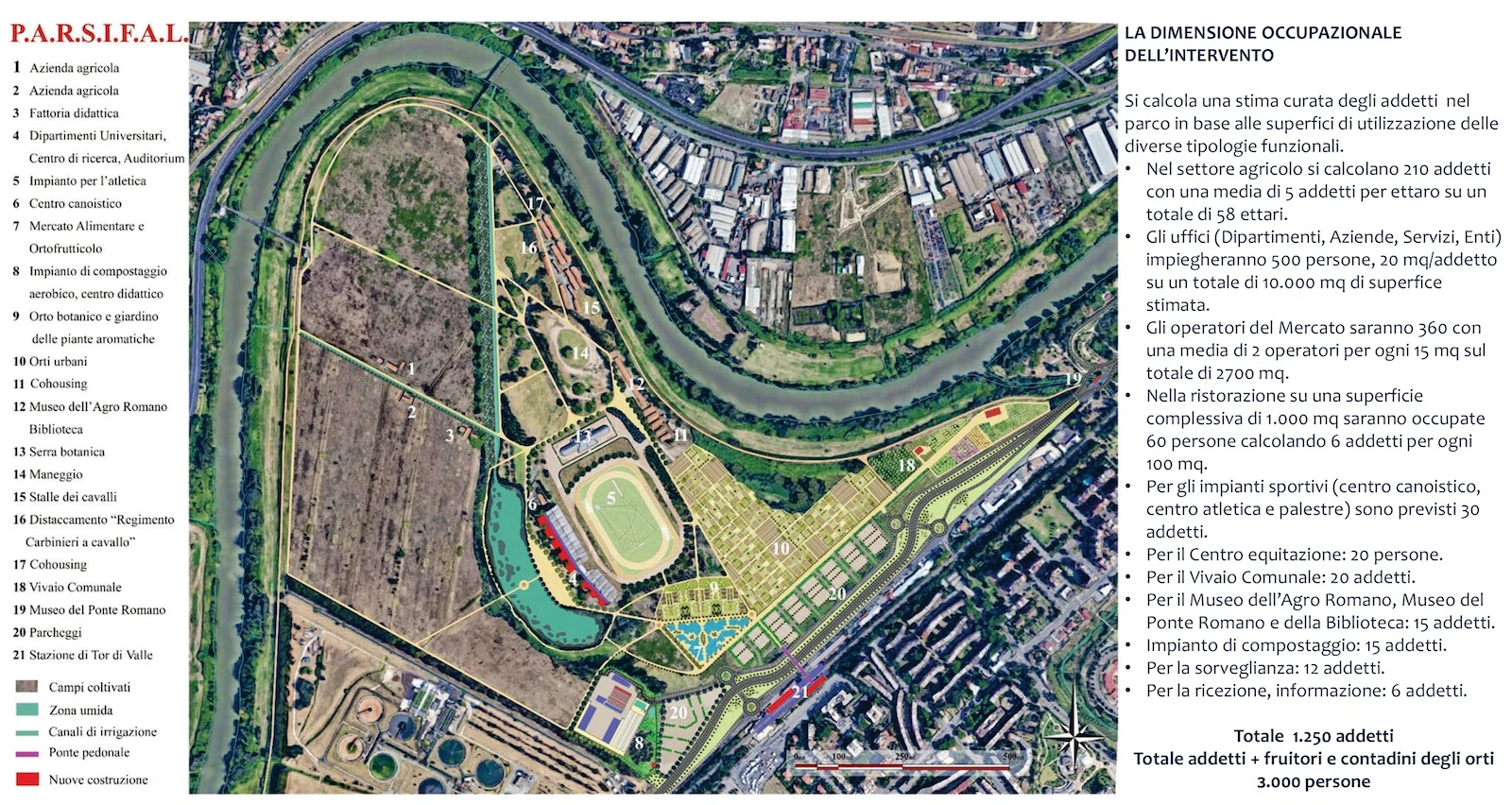
Slide 8/8
In total, the Park would employ approximately 1,248 people. This significant employment figure is due to the highly interconnected nature of the Park's various functions. Naturally, this figure must also be understood within the context of close dialogue with schools, universities, and public and private research bodies, whose relationship with the Park goes beyond their physical presence on site and is developed through initiatives, exchanges of information, and activities that are tangible expressions of vitality and interaction with the education and training system in the broadest sense, aimed at attracting young students and talented workers.
The specialisations involved, broadly falling within the agricultural, environmental, urban, and green-technology fields, cover many diversified yet interrelated areas which range, just to mention a few, from the food sector to the energy sector, from pharmaceuticals and chemistry to applied biology, from landscape to construction, from tourism to business services and cultural production. Operationally, the aim is to enable the Park's network to act as a community, sharing resources, challenges, good practices, and project ideas, and to achieve stronger coordination of its initiatives, thereby generating positive impacts on the surrounding areas and on employment.